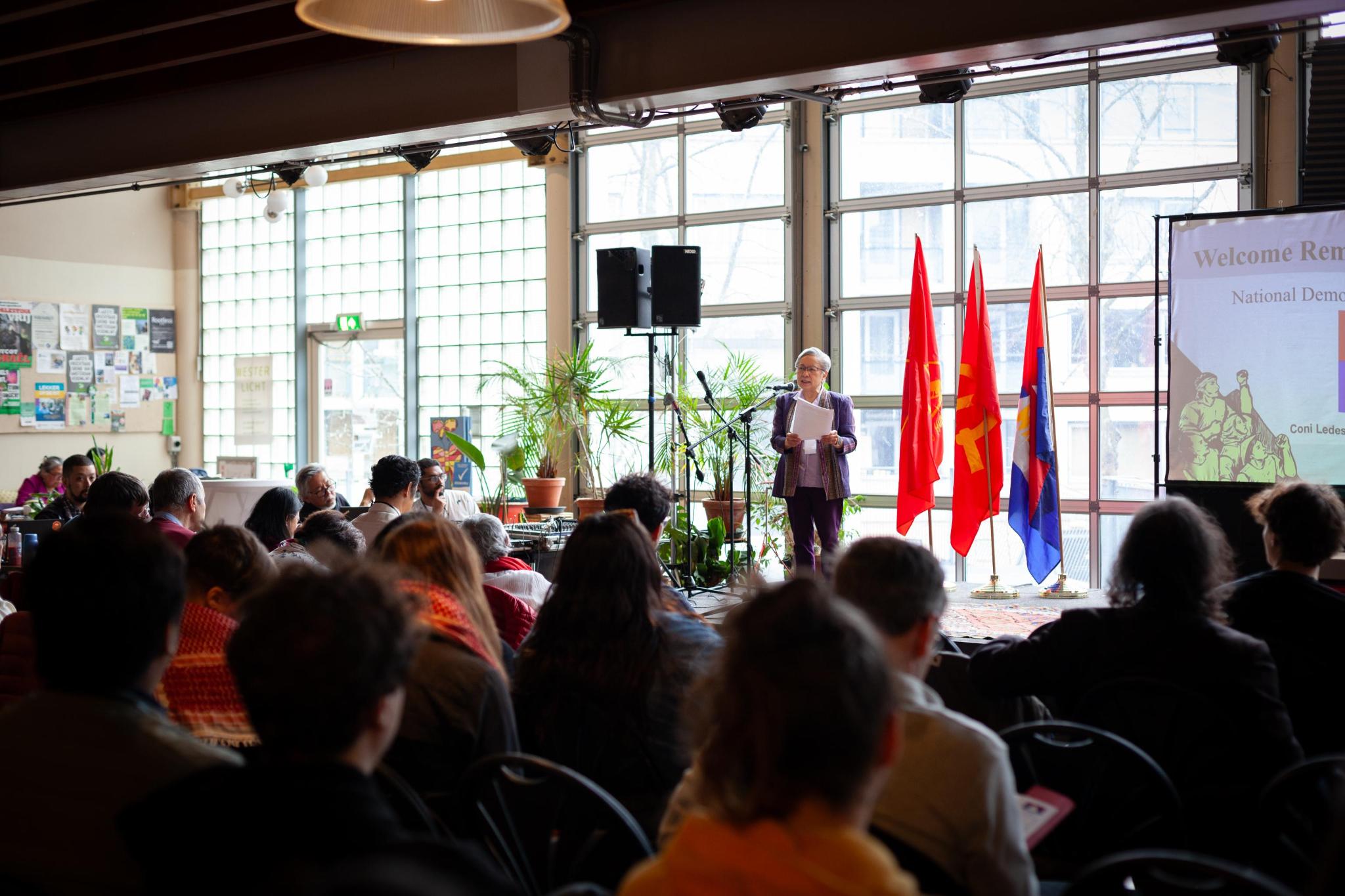
The current global situation is one of rapidly worsening economic crisis and ever-intensifying armed conflicts. This backdrop for the second international theoretical conference held by the National Democratic Front of the Philippines (NDFP), on the theme of “economic crises of imperialism,” lent an added urgency to the conference, which gave all involved the opportunity to share their various views, open up discussions and debates, and renew and strengthen their relationships with each other.
Over the two days of the conference the various speakers and attendees engaged with the broad theme of the conference and its suggested topics from the point of view of their respective organizations, alliances, and movements. Ninety-eight conference delegates from different proletarian-socialist, anti-imperialist, and democratic parties and sectoral organizations, hailing from 18 countries around the world, considered the subject of imperialist-driven economic crises through three main topics: 1) the crisis of capitalist overproduction; 2) financial crises and trade wars; and 3) the climate and environmental crises.
The discussions resulting from the various inputs and interventions coalesced into several major themes:
- Inherent nature of crises in capitalism
- History and development of capitalist crises
- The development of capitalism into imperialism
- The present general crisis and the dominant trends in the current period
- Financial crisis and trade wars
- Climate and environmental crises
- Impacts of the crises on the toiling classes and oppressed sectors
- Prospects and opportunities
Inherent nature of crises in capitalism
The presentations and discussions expressed understanding of, and general agreement on, the Marxist analysis of capitalism and the inherent nature of crises in capitalism: its basic contradictions and mechanisms that create the bourgeoisie and the proletariat, drive class struggles, and generate many types of crisis mostly rooted in overproduction.
Many inputs began their analyses of economic crises under imperialism by pinpointing their origin in the basic contradiction of capitalism, namely, between the increasingly social character of production, on the one hand, and the private appropriation of the wealth created in the process of production, on the other. The nature of capitalism is to employ capital in large-scale production to exploit the workers’ labour power and create surplus value. This drives the capitalist motive to accumulate profit by mass-producing and selling commodities at the highest price and the least cost, leading to anarchy and competition in the market, and the inevitable tendency of the rate of profit to fall. These economic forces eventually lead to repeated crises of overproduction. As a result, profit and wealth are enjoyed by fewer and fewer individuals, while society as a whole suffers from massive unemployment, impoverishment, and wasted resources.
History and development of capitalist crises
As a means of tracing the roots of the current economic crises, many inputs noted the long history of capitalist crises in the past two centuries, from the repeated cycles of crises of overproduction, as first observed by Marx and Engels and validated by the next generations of revolutionaries, to the development of capitalist crises in the imperialist era. As capitalism continues to develop, these crises overflow and begin to affect all aspects of social life: disruptions of commerce and finance, bankruptcies, growth of monopolies, societal breakdown, and other related factors that also trigger colonial conquests, political conflicts, wars, and social upheavals. While these crises exacerbate the lives of the working class, they also provide the objective conditions for the advance of working class movements, opening up possibilities for the emergence of socialist aspirations and actual socialist revolution.
The development of capitalism into imperialism
Around the end of the 19th century, capitalism reached the stage of monopoly capitalism, or modern imperialism. In their analyses and in the open forums and discussions, many made mention of the main features of this new stage, as comprehensively analyzed by Lenin and subsequent generations of Marxists and socialist/communist/worker’s parties: a) the rise of monopolies in advanced countries; b) the merging of industrial capital and bank capital to become finance capital under the control of a financial oligarchy; c) the export of this capital to other parts of the world; d) the rise of international monopolies; and e) the total division (and repeated redivision) of the world among the biggest capitalist powers.
These features signified that capitalism had reached the stage of imperialism, which intensified the contradictions of capitalism and its many crises, including the greed for resources and colonies, and the bloodlust for war. These features are indicative of the moribund and parasitic nature of imperialism as the final stage of capitalism, signalling that the era of the proletarian socialist revolution throughout the world is close at hand. In the age of imperialism, the intermittent crises of free-competition capitalism evolved into a general crisis involving the entire world. Throughout the 20th and early 21st centuries this general crisis passed through different stages, which were taken up in various ways by the conference participants.
The present general crisis and the dominant trends in the current period
Many of the papers and discussions focused their analyses on the period since the 1970s, and especially since 2008-2009 when the global general crises further intensified under imperialism’s neoliberal regime.
The U.S. imperialist-led neoliberal onslaught was in the form of policy impositions forced upon the entire world, especially on neocolonies and oppressed peoples, through global economic, financial, and other agencies and institutions such as the World Trade Organization (WTO), the International Monetary Fund and the World Bank (IMF-WB), as well as regional organizations and cooperative agreements. Other formations such as BRICS and the Shanghai Cooperation Organisation (SCO) have emerged in reaction to these U.S.-led neoliberal impositions but are also affected by the same basic mechanisms of the global imperialist crisis in production, finance, and trade.
The greatest impacts of these trends, as described in many of the inputs, have been to labor (e.g., drastic changes in the terms of employment, job security, wages, labor standards, and union rights) and to small farmers and other toiling people (in terms of access to land, resources, and livelihoods).
New technological innovations have exacerbated the effects of these impacts, as heard in numerous examples given over the two-day conference. All countries, peoples, and classes have suffered various social-economic impacts from the latest generation of high technologies, including large-scale automation and AI-robotic applications in many fields, including industry, finance, communications, transport, and other services. These have resulted in further contractualization, informalization, and fragmenting of the working class, e.g., through the so-called ‘gig economy.’ There are also high-tech military, police-state, and propaganda applications that are being mobilized against the peoples’ interests.
These neoliberal impacts also cause massive migration flows, which further worsen all other aspects of the economic crisis.
In the past several decades, the crisis is further aggravated by inter-imperialist conflicts, especially through wars and the bloated arms industry, which intensifies other aspects of the crisis such as environmental damage, forcible dislocation of communities, and health hazards, which in turn worsen mass migration.
Imperialist-controlled media and cultural hegemony, further enabled by high technologies, have played the role of covering up the real roots and culprits behind the crisis and distracting the people away from long-term revolutionary solutions.
Financial crisis and trade wars
The financialization of various aspects of socio-economic life has created factors that aggravate the current general crisis of imperialism. These powerful factors are most clearly seen in the rampant speculation in all kinds of financial instruments (including derivatives and cryptocurrency), bloating up financial bubbles that eventually burst. They are also seen in the advanced capitalist powers carving out their global market spheres of influence and alliances (through WTO instruments and so-called “free-trade” pacts), which eventually turn sour and become trade wars.
The impacts of the financial crisis and trade wars are felt worldwide, in falling wages, worsening working conditions, rising unemployment, business closures, and land and resource grabbing.
The imperialist crisis is affecting the entire world. The strategic decline of U.S. imperialism is such that its unipolar dominance has ended, while other poles (including Russia and China) have emerged to challenge it and to take advantage of countries decoupling from U.S. hegemony in trade and finance, as shown by the trend of ‘de-dollarization.’ Although these rising powers are benefitting from the U.S. decline, they are not exempt from the continuing general crisis.
Climate and environmental crises
A major consequence of economic crises of imperialism, and a major cause of concern for all conference participants, is the increased exploitation of people and planetary resources, accelerating climate change, and the destruction of the biosphere’s ecological balance and ecosystems. In response to this existential threat, people across all classes and countries are joining massive street protests to defend the environment and demand system change.
However, not all people are equally impacted by this crisis. Many rightly noted that the most vulnerable to its effects are the overexploited countries and their toiling masses, while it is imperialist countries, in their corporate greed and military madness, that cause the most damage.
Imperialist-proposed solutions to the climate crisis (e.g. carbon offsets and trading, climate financing, pushing ‘clean technologies’ merely as new markets for increased profit) only create new problems and redirect focus from genuine ecological solutions. Communist parties, national liberation movements, and progressive political formations must give sufficient attention to the environmental crisis in their analyses and their organizing and provide an alternative analysis and position to these false solutions. Peoples’ movements must expose these machinations for what they are and emphasize that the only decisive way out of the climate emergency is through the overthrow of imperialism.
Impacts of crises on toiling classes, oppressed sectors
On the industrial and service proletariat, on the semiproletariat and so-called “precariat”
Workers in various countries have been affected by these consequences of economic crises under capitalism. In imperialist countries the housing crisis is leading to the epidemics of homelessness and widespread and problematic drug use among workers, as in Canada and Australia, and rampant food insecurity among working families. Some countries are seeing a reversal of the neoliberal trend of outsourcing, whereby companies are relocating and returning to the imperialist core, to countries like Spain and Japan. Economic protectionism is spurring the building of factories in imperialist countries that are intended to strengthen the capacity of these powers to be technologically self-sufficient, especially in the field of modern electronics and energy, such as the motive behind US CHIPS Act. The mobility of capital and the free movement of companies to set up shop in different locations, potentially circumventing resistance movements that may arise to challenge their presence, pose a challenge to workers’ movements in their organizing work. Many inputs understand these developments as occurring within the context of inter-imperialist competition to control the resources and machineries that create the technology that billions rely on.
Economic protectionism in the US and Europe is also in lockstep with the rise in ultra-right-wing and fascist governments based on national chauvinism and racism. Increasingly strict immigration policies in high-income countries have altered labor migration flows, so that more “irregular” migrant workers are gravitating towards upper-middle-income countries whose economies are receiving a boost from the relocation of labor-intensive production to underdeveloped regions, and whose doors open to receiving migrant workers willing to work in precarious, unsafe, and dangerous working conditions. Highly skilled workers, on the other hand, are still in demand by wealthy states, facilitating the brain drain from poorer countries and worsening the cycle of underdevelopment and migration afflicting many overexploited countries. If the models of Brexit and Fortress America continue to gain relevance among western imperialist states, there is a growing need for organizations of the working class to answer the question of how they will respond to the closing of their respective countries’ borders to migrants.
In many countries, these symptoms of economic crises of imperialism have triggered waves of labor unrest and popular resistance, in the form of spontaneous uprisings like the convoy protests in Canada, mass struggles on the pension reform issue in France, and an upsurge of workers organizing of various structures, from unions to assemblies to councils. Migrant worker organizing continues to build movements on the ground to link the battles for rights and welfare with the struggles against imperialism in their home countries, towards addressing the root causes that push migrants to leave. Many parties in attendance underscored the important task of building a vanguard organization capable of harnessing this energy and wresting it away from the influence of reactionary leadership.
On the peasantry, other rural peoples
The peasantry and other rural peoples are impacted in particular ways under economic crises of imperialism, due in large part to widespread land- and resource-grabbing, super-exploitation under policies of neoliberal globalization, and the uneven effects of the climate crisis.
The farmlands that provide the world’s peasants with their livelihood have not escaped the bane of financialization, with land concentration in the hands of the elite at its most severe today than in the last three decades. Land monopolies and the subversion of domestic food systems in favor of TNC-driven crop production for export have led to a global food crisis, resulting in widespread starvation among food producers, landless farmers, other rural poor and indigenous peoples. Nor has the agricultural sector been exempt from the effects of digitalization, where peasants, especially women, are being displaced by new labor-saving technologies, as in India, Uzbekistan, Pakistan, and countries across Africa.
Land grabbing has also contributed to the flow of internal migration and the phenomenon of so-called “urbanization,” where landless peasants swell the ranks of the urban poor in slums the world over, from Mumbai to Cape Town to the Manila harbour.
On women, youth and children
The conference was presented with examples of how women workers and peasants are particularly affected by the trends and policy impositions present in this current era of economic crises under imperialism.
Trade policies and agreements have a particular impact on rural economies and on those agricultural sectors which have a central role in rural women’s livelihood and the lives of their families. In Pakistan, for example, the women-dominated areas of livestock husbandry and small-scale dairy farming are increasingly under threat by multinational corporations who want to control the dairy market.
The AI boom, and the increase in digitalization, are employing women by the hundreds of thousands in electronics sweatshops, producing chips and memory cards, as well as in digital sweatshops, where women workers in countries like Kenya and the Philippines toil to train the AI models that make lives easier for those in imperialist countries.
With women often being the primary caretakers for children and families, when women are disproportionately affected by economic crises there is a consequent deleterious effect on the health and wellbeing of their dependents.
For youth growing up in imperialist countries or influenced by imperialist hegemony, the culture of bourgeois decadence encourages individualist, apathetic, and escapist tendencies, characterized by the promotion of vices and the revival of superstitious and reactionary theories.
Participants from the women’s sector reiterated that the struggle of women and their families are part of the class struggles of the toiling masses against their ruling-class exploiters and oppressors. It is only through taking the path of revolutionary resistance alongside others of their exploited classes and oppressed sectors, can women stand up to and seek liberation from imperialism.
On indigenous peoples and minority nationalities
The analysis of impacts from different sectors, especially those coming from peasant organizations, the environmental sector, and countries where indigenous peoples and national minorities form a significant part of the population, made mention of the particular impacts of imperialist crises on these groups.
The history of the development of capitalism into imperialism, including the damages of colonization on the lands, cultures, and lives of indigenous peoples is essential for understanding the contemporary situation of indigenous peoples, who continue to be displaced from their lands by resource extraction and development aggression. These encroachments, coupled with the intensification of climate disasters like forest fires and floods, disproportionately affect rural and indigenous communities.
Prospects and opportunities
The conclusion that many in attendance drew from the current global crisis is that objective conditions that are ripe for great revolutionary leaps of proletarian parties exercise the correct leadership, build strength, and harness the full power of the masses.
Imperialism’s general crisis continues to worsen from year to year, made sharper still by fascist or police-state measures, military buildup, and imperialist-backed or proxy wars. Social unrest is overflowing into organized and spontaneous mass protest. There is massive outrage against the worst economic impositions and state/corporate abuses against the world’s peoples, including plunder and genocide.
The masses who join spontaneous struggles may be receptive to revolutionary influence, but many are still led or influenced by reformist groups; some are even used and led astray by rival imperialist or reactionary factions. So, there are opportunities for both revolution and counter-revolution.
The only way out of imperialism and its bottomless crises is through revolutionary change towards socialism, which is borne on the shoulders of the working class. Revolutions are mass undertakings. In organizing the masses, the revolutionary and pro-people forces are adjusting to concrete conditions and grappling with questions of correct class leadership in both strategy and tactics. This requires integrating with the masses, understanding their concrete needs and capacities, and providing the best paths for them to advance.
Proletarian parties in their respective countries must therefore continue to build themselves, enrich Marxist theory and apply it to concrete practice, rectify errors and overcome long-standing weaknesses, and lead the masses to wage struggles to win victories. At the same time, we must be conscious of all-out imperialist propaganda efforts to spread disinformation, shape mainstream “public opinion” in their favor, offer new false solutions, and continue to deceive the masses.
Most of the conference participants agreed that capitalism has been decisively restored in former socialist countries such as Russia (as were the rest of the former Soviet Union) and China. It remains a subject of much debate, however, in this conference and elsewhere, whether these countries are now manifesting the same worst evils of imperialism shown by the U.S. and its Western imperialist allies, and thus must be targeted equally as main enemy of the peoples of the world, or on the other hand, if they have retained enough vestiges of anti-imperialism, or positions not typical of imperialism, that make them the “lesser evil” and possible tactical allies in some people’s resistance movements against U.S. imperialism or its client states and puppet forces. Whatever the position of a party on this question, the reminder from many participants is that these questions cannot be tackled solely in the realm of theory, but must be grappled with in practice, in the respective struggle of each party to wage revolution against the big bourgeoisie in their own country. The question, “for whom” takes precedence; the more important consideration is for proletarian parties to assert their position on the side of the working class and oppressed peoples rather than declare sides in geopolitical conflicts between imperialist powers.
It is important for each proletarian-socialist party to, first of all, study the basic characteristics of their own society and the workings of imperialism within their own country, and to apply their study of Marxist, Leninist, and Maoist theory to the task of waging, advancing, and winning victories in their struggles for national and social liberation in their countries. This involves a need to thoroughly study the international situation and investigate and analyze the trends and patterns happening in the world, in order to take practical advantage of the opportunities provided by these conditions to win the revolutionary struggle within their respective countries while extending support to other peoples fighting imperialism and reaction.
At the same time, revolutionary and pro-people forces in the various countries should maximize opportunities to share experiences and lessons widely, engage in discussions and debate amongst themselves, and practice international solidarity in the spirit of anti-imperialism and proletarian internationalism. This is precisely the spirit in which events such as these theoretical conferences are held.
The call for international solidarity, and further, international cooperation among proletarian socialist, anti-imperialist, and progressive forces, which arose last October, was echoed again in the discussions and inputs from this conference. For Marxist-Leninist parties, there is a demonstrated need to cooperate to define and firmly grasp their urgent tasks to decisively defeat imperialism. Though there are varying levels of unity on specific issues among the different participants, an openness to some level of international coordination was a common sentiment shared by many.
The prospects are bright for waging mass struggles and advancing people’s demands in various fields to fight the crisis on revolutionary terms, and for eventually winning proletarian revolutions and liberation struggles in various countries, in order to overthrow imperialism and reestablish socialism on a yet wider or global scale.