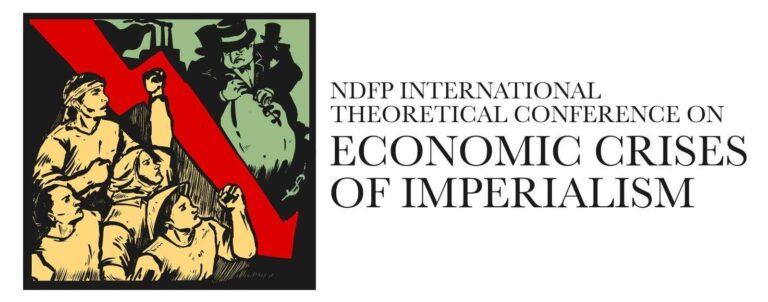

Nick G., Chairperson, Communist Party of Australia (Marxist-Leninist)
March 2024
1. Over-production
Under imperialism, the threat of economic crisis is always present. Although a general crisis of over-production on the scale of the Great Depression has been averted by various means, 1 its repetition cannot be ruled out, and its echoes recur on a regular basis, sometimes with over- production as a central feature in one area of economic activity or another, and sometimes as crises born of finance capital’s ascendancy in the imperialist era.
Over-production is inherent in capitalism. It is born of the need for capital to constantly seek to increase profits by expanding production and dominating the market for sales and hence, for the realisation of the surplus value created by workers’ labour power. It exacerbates the contradiction between the scientifically planned approach to production in individual workplaces, and the absence of central planning of economic activity under capitalism, which results in an anarchistic and competitive scramble for control of markets by the capitalists themselves.
The general tendency towards crises of over-production under capitalism is subject to the law of uneven development so that there can be problems in one economic sector but not in others. Bourgeois economics, and particularly Keynesian economics, shifted the responsibility for over-
1 By reducing the temporal and spatial differences between production and sales, capitalists hoped to better understand the market and adapt their production schedules to it. In the 1970s, the Japanese Toyota company introduced a just-in-time (JIT) inventory system that aligned raw-material orders from suppliers directly with production schedules. In the 1980s, JIT was adopted by manufacturers throughout the capitalist world. With the deregulation push of the neo-liberal era, the JIT system was applied to the workforce. Widespread attacks on labour laws gave capitalists the right to dismantle permanent, full-time employment and only bring in labour when they needed it in a stop-start production system. Workers were called in to work only when needed for a particular product run, and then sent home. This phenomenon of precarious employment was widespread by the turn of the century and has created a precariat with few rights, and unpredictable but lower wages. Those manufacturers who engage in direct marketing for online sales hope to further marry production to market requirements by eliminating the time between production and the realisation of surplus vale, but all they have been able to do is ameliorate to a certain extent the causes of capitalist over-production without eliminating them, because that is simply impossible so long as profit remains the motive behind production.
production from the capitalists and their insatiable drive to expand production to chase profits, to the workers, generally the largest market for goods and service. These economists spoke not of over-production, but of under-consumption. Marx disproved Say’s 1803 Law, which held that supply inevitably generates demand, but it constantly reappears in various guises.
Following the 1930s Depression, Keynesian economics became very influential. If capitalists fought against wage rises for their own employees, the compound effect was to reduce the purchasing power of the workers as a class. To offset their “under-consumption” without forcing employers to stop their attack on wages, the “welfare state” saw the adoption of government spending on social benefits and services intended to compensate workers for their low wages.
In Australia, the last gasp of Keynesianism occurred under Labor Prime Minister Bob Hawke. Supported by the revisionist Communist Party of Australia, unions were forced to forego wage increases in return for Government spending on a “social wage” of improved benefits and entitlements in areas such as health and education. The resultant wage freeze continued through the recession of 1989-90. Hawke’s Treasurer and successor as Prime Minister, Paul Keating, emphasised free markets, globalisation, deregulation, and privatisation. He also sought to extend the wage freeze by offering workers a scheme for compulsory superannuation payments, with both the worker and the employer required to contribute, with workers unable to access their super funds until the retirement age of 65.
It was the Labor Party that pioneered the Australian embrace of neo-liberalism. Keating was a Prime Minister for imperialist finance capital.
The defeat of Keynesianism and the ascendancy of neo-liberalism were accompanied by international economic crises associated with, but not directly arising from, the general tendency towards over-production.
They included the early 1980’s Debt Crisis during which commodity prices fell through over- production, although the main problem was the inability of developing countries to sustain their sovereign debts to international finance capital.
On Black Monday, October 19, 1987, global stock markets experienced a sharp crash. The Dow Jones Industrial Average dropped by over 22% in a single day. Over-production was not a primary cause for the crash: technologies facilitating large sell orders automatically and globally, in a market where a flood of speculative capital had over-valued stock prices, were a large factor.
In 1997-8 the Asian Financial Crisis occurred. Thailand, Indonesia, and South Korea, faced severe currency devaluation and financial instability. Like Black Monday, the AFC was linked to the machinations of imperialist finance capital and the burdens it imposed on developing economies. When the Thais unpegged their baht from the U.S. dollar to try and minimise their exposure to debt, it lost half its value against the U.S. dollar within months. Other Asian currencies followed.
The next major economic crisis was the dot-com bubble burst of 2000-02. It was largely a crisis of financial speculation as venture capital flowed into so-called start-ups with no proven production
history, over-valuing the share prices. When this venture capital failed to realise the expected profits, it was withdrawn in search of other opportunities, leading to a sudden sharp decline in the NASDAQ Composite Index. To the extent that electronic goods were over-produced in a bid to create and capture new markets, online retailers like eBay and Amazon facilitated distribution and sales.
The Global Financial Crisis of 2008-9 had its origins in an over-supply of private residential housing in the United States. To encourage sales, the poor, the blacks, the Latinos, the single women with children were offered “sub-prime” or high-risk NINJA loans (“no-income-no-job” applicants) in pursuit of the bourgeois ideal of home ownership. Increasing numbers of these would-be home-owners found that once the introductory discount repayments were reset, they were unable to meet the higher real and long-term repayments that were required.
In the scramble to sell over-produced housing, speculative investors seized upon new financial instruments which allowed them to bulk purchase sub-prime mortgages in many cases, as soon as they were written. And to make their sale more attractive, they were often parcelled together with a smaller number of prime, or less risky, mortgages or other types of debt. The structure of these packages, (called collateralised debt obligations or CDOs), made them vulnerable to collapse. For a time, there was frenetic trade in financial packages of debt. CDOs were sold, repackaged, sold again, and even became CDOs of nothing else but other CDOs!
Why was finance capital driven to seek such opportunities in speculation?
Money as finance capital continually searches for ways in which to more quickly and effectively make returns on its own value. The use value of capital resides in its ability to remake its own value over and over again for the benefit of its owner. If it is simply sitting in an account then apart from its interest-earning function, it is effectively dead capital, capital without a use, or a use restricted to the minor returns of interest payments.
The speculative and parasitic character of the finance capitalists is determined by their need to seek higher and higher returns on the capital they own. One option is to invest in the process of production and realize returns in the form of the surplus value created by workers through their labour power. But the rate of profit through the exercise of this option is restricted by part of the capital becoming constant capital (plant and machinery, raw materials) in production, and fixed capital (plant and machinery) in the distribution or flow of capital. There is a determined length of time in all of this before returns outvalue the investment.
A better option (for the owner of finance capital) is to use it in situations where its current value is gambled against the potential for a faster gain in the form of more capital. The stock market, an early development in speculation under capitalism, is precisely such a form of parasitic gambling. The purchaser of shares does no useful productive work, but hopes to benefit by dividend payments and eventual resale of the shares at a profit when their price rises. Purchase of various types of bonds with guaranteed rates of return is somewhat less speculative, but no less parasitic.
Technology has created a bewildering array of permutations on the original functions of the stock market. Futures trading (derivatives), currency trading, swaps and naked shorting are rampant in the world of finance. Gains can be made in seconds.
The recession that accompanied the Covid-19 Pandemic in 2020 caused a global economic downturn, and was the most severe recession since World War 2, affecting economies around the world. Many workers lost their lives and many were placed under shut-down restrictions whose duration varied from place to place. Without wages coming in, inventories accumulated in some parts of the economy with over-production in some sectors. In others, severe shortages occurred as global supply chains were disrupted and production was disrupted as workers were stood down.
At the beginning of the pandemic, Australia had a conservative Liberal government which recognised that without the ability of workers to purchase commodities, there would indeed be a general crisis of over-production. So, they fell back on some social-democratic approaches, creating a JobKeeker wage subsidy, encouraging bosses not to retrench their workers by providing financial assistance to cover part of their wages. Typical of capitalists when there is government money made available to them, there were a number of scandals where giant corporations rorted this system and simply lined their own pockets. In addition to this, the government provided tax-free cash flow support to small and medium-sized businesses.
The government also provided income support for individual workers and several payments of A$750 to a wide range of eligible recipients.
A more significant measure was to waive the limitation on individuals accessing their superannuation prior to reaching the requirement age. The conservatives had an ideological problem with employers being compelled to contribute to their employees’ superannuation and wanted to unlock the savings in superannuation funds. Under the guise of helping workers to cope with the recession, they allowed all employees to have easy access to their superannuation, allowing them to make two withdrawals of $10,000 each. Nearly 1 million Australians out of a total of 17 million “closed or largely cleaned out their superannuation account as a result of early release payments.” Another 1.6 million withdrew lesser amounts, but the total of all withdrawals was $38 billion. By workplace sector, the largest numbers of people raiding their superannuation were construction and mining workers (40%), mobile plant operators (37%) and factory process workers (35%).
This reversion to Keynesian measures during the recession put money in the hands of the workers and helped ease the tendency towards a crisis of over-production.
Nevertheless, over-production remains endemic in the capitalist economy.
Agriculture – sheep and cattle, dairy, grains, fruits and vegetables – have a range of additional external factors at play, not least of which is climate variability. Three years ago, sheep prices in Australia were at record highs. From then, and the two following years, Australian farms received higher than average rainfall. With grass in abundance, and sheep prices high, farmers increased their flocks by 23% between 2020-3. The 79 million sheep, however, were far in excess of the
domestic market’s needs and that of export markets. Lamb prices fell 40% to the lowest prices since 2014. Some of the 33,000 family-run farms found that the cost of freighting sheep to sale yards was greater than the revenue from sales. That led to the only solution to over-production of agricultural products: their deliberate destruction and wastage. Small and medium-sized farmers in particular had no option but to shoot their sheep and bury them. While so much of the world goes hungry…
Two notorious examples of the wastage inherent in capitalist over-production occurred outside Australia. In Britain, a 2021 report disclosed that Amazon was destroying millions of items of unsold stock every year. In addition to its own stock, Amazon serves as a sales platform for a multitude of companies with products to sell. One of its 24 distribution centres in the UK had a target of 130,000 items per week that it had to get off shelves and into dumps. The items included smart TVs, laptops, drones, books, computer drives and 22,000 Covid face masks. The incredible wastage has led the European Union to legislate to prevent surplus goods going to landfill.
Early last year, another scandal erupted when the US company Funko Pop, manufacturer of collectible PVC figurines that stand about 10-12cm high, was forced to send $36 million of stock to landfill. Between 2021-2, Funko’s inventory had soared by 48%. By March 2023, the storage costs of unsold product outstripped their market value. Hence the giant dumping exercise. Its workers were also sent to the scrapheap. In July 2023, Funko laid off between 180-200 employees, representing about 12-13 percent of its workforce.
Another industry sector notorious for its over-production and wastage is the fashion industry. It is estimated that one truckload of perfectly wearable textiles is dumped in landfills every second. In 2022, the value of the global fast fashion market soared from US$106.42 billion to US$122.98 billion. Luxury brand Burberry reported in 2018 that it had destroyed goods worth US$37 million.
Fashion accessories are included in the incredible waste of perfectly good products. Between 2016- 18, Swiss watch manufacturer Cartier and Montblanc spent $744 million buying back unsold designer watches from distributors which they then destroyed. They claimed that if they had allowed these over-produced goods to be sold at a discount price by traders, it would have damaged the luxury status of their brand name.
Australian workers are currently suffering a cost-of-living crisis, with low wages, interest rate increases, and housing shortages. Almost no rental properties are considered affordable for the lowest-income 30 per cent of households. There are billions of dollars invested in large commercial office buildings in all cities in Australia for speculative purposes. Big banks and “developers” like Charter Hall, Investa, Stockland build, buy and sell city office buildings for enormous profits. Even industry superannuation funds and overseas owned pension funds such as Canada’s Ontario Teachers’ Pension Fund invest hundreds of millions of dollars in city office and retail to make quick profits by selling at a higher return and repeat the process again and again.
They invest very little in housing because they don’t make a big enough profit to satisfy their institutional shareholders.
Capitalism is a terrible system. It impoverishes and drives into despair the most vulnerable sections of one class, while increasing the wealth and luxury of another. Four months ago, the Guardian reported that the typical CEO in Australia now earns 55 times that of the average wage worker. More and more workers rely on charities for food and other household goods.
In some countries, donations of over-produced goods to charities can be a tax write-off. Where charities have traditionally supported the homeless and long-term unemployed, Foodbank, a charity food distributor said at the end of 2023 that it is no longer the homeless who are seeking assistance, but people in the ranks of the working class, who are renting or have mortgages, who are finding in the current crisis, that they really can’t make ends meet. Accusations of price gouging have been levelled at the two monopolies that dominate the supermarket industry. They are accused of impoverishing their suppliers while keeping food prices beyond the reach of those now having to seek food relief.
The same phenomenon appears across the retail sector. Good360, a charity that delivers unsold consumer goods to a network of over 3,700 charities and disadvantaged schools, has seen a 20% increase in the volume of unsold products from retail businesses in the 12 months to September 2023. A 2022 report by Deloitte Access Economics found that A$2.5 billion of unsold household goods were going to landfill instead of to people in need. Good360 redistributes a small part of that, amounting to millions of dollars’ worth, and claims that it is supporting twice as many people in hardship than it was at the height of the Covid-19 pandemic.
We don’t have the space here to look at over-production and falling profitability in the solar panel industry, but refer comrades to an interesting study at The ‘wicked trinity’ of late capitalism: Governing in an era of stagnation, surplus humanity, and environmental breakdown – ScienceDirect
.
Imperialist monopolisation is accelerating the capitalist economic crisis and deepening the unsolvable contradictions of capitalist social relations of production. Monopolisation in food production and distribution, energy, finance and banking are increasing the economic burden on the people. It is predicted that within 4-5 years family farming in Australia will disappear replaced by the corporate agri-business. This will have an enormous impact on rural communities, towns and the cost of living.
The dominance and control of Australia’s economy, mainly by US monopoly capital, is restructuring the economy to fit into and serve the global imperialist military industrial complex.
2. Financial crises
The growing of tulips in Holland has not featured as a major world economic crisis for a while – but it did feature in 1636-7 as probably the first time that a speculative bubble had burst with destructive social consequences. It led Marx to believe that “All nations with a capitalist mode of production are seized periodically by a feverish attempt to make money without the mediation of the process of production.”
In Chapter 26 of Capital Vol 3, Marx quoted J.W. Gilbart’s 1834 study of banking, that “whatever gives facilities to trade gives facilities to speculation. Trade and speculation are in some cases so nearly allied, that it is impossible to say at what precise point trade ends and speculation begins.” Marx followed this by saying “The easier it is to obtain advances on unsold commodities, the more such advances are taken…”.
Marx said that capital divorced from claims on future production was fictitious capital whose “market value is determined differently from their nominal value, without any change in the value…of the actual capital” (Marx Capital Vol 3 chapter 29). Such market value is determined “not only by the actual income, but by the anticipated income”.
Speculating on the future value of a commodity runs through the stock market. But part of bank capital and the whole of capital invested in stocks and shares is fictitious in the sense that “All connection with the actual expansion process of capital is thus completely lost, and the conception of capital as something with automatic self-expansion properties is thereby strengthened” (Marx, ibid).
If that was the case during the period of free capitalism, when Marx was writing, it has only gotten worse during the imperialist, or monopoly, stage of capitalism. The imperialist era saw the ascendancy of finance capital over bank capital. The provision of credit had been a means of buying a legal right to a share of future profits from production through the stock market. But as we said earlier, finance capital must continually search for ways in which to more quickly and effectively make returns on its own value. Credit in the form of investment capital being utilised to purchase a legal right to “a mere phantom of the imagination” (Marx, ibid) generates a general tendency to financial crises in the imperialist era. Those crises are likely to see the bursting of tulip bubbles on a much larger and dangerous level.
One of the largest forms of fictitious capital is the derivative, basically a speculative contract on the future value of an asset which could range from a grain crop, to the weather, or to interest rates. Australians were once said to gamble on anything including two flies crawling up a wall. Add in some technology and you have the derivatives market.
The inflated value of derivatives has reached such proportions that talk of a bursting bubble is never far away. What makes an estimation of the value of derivatives difficult is that they come in two forms- privately traded Over The Counter (OTC) derivatives and Exchange-Traded Derivatives (EDT). The latter is a regulated trade and its value can be known. The former is out of sight of regulators and can only be guessed at. These represent the majority of trades in derivatives and the market for them is dominated by hedge funds and private equity firms.
In 2002, mega-investor Warren Buffett wrote that derivatives were “financial weapons of mass destruction.” At that time, their total “notional” value (the value of the underlying assets from which the “derivatives” were “derived”) was estimated at $56 trillion.
In 2009, and again in 2014, the value of fictitious capital represented by derivatives was estimated by the Bank of International Settlements at a quadrillion US dollars, or a thousand trillion dollars.
The value dropped after 2014, but in 2022 the Bank of International Settlements set the notional value of all outstanding global derivatives contracts at an astonishing $2.5 quadrillion. This figure is equivalent to over 30 times the worldwide GDP.
In 2008, fictitious capital gave rise to its own fictitious currency, Bitcoin, a cryptocurrency. This occurred at the time of the Global Financial Crisis and was held to be beyond the control of banks and regulators. There are some who argue that Bitcoin is a real currency, and it has been adopted as such by one or two of the poorer countries. In 2010, the first known commercial transaction using
bitcoin occurred when programmer Laszlo Hanyecz bought two Papa John’s pizzas for
₿10,000.
The price of a Bitcoin reached its height in 2021 at US$64,000, then dropped dramatically, but has now recovered at a new height of US$69,000. The total cryptocurrency market fell by more than 60% after 2021, but as of March 7, 2024 the global cryptocurrency market value is $2.64 trillion, a 149.28% change from one year ago.
Just as fictitious capital has a range of financial instruments (derivatives, credit default swaps, CDOs etc), so cryptocurrency is witnessing speculative deployment of capital in the form of Contracts for Differences (CFDs) based on the differences between the opening and closing prices of the nominated cryptocurrency over a define period of time. If ever there was a case of Marx’s gambling on mere phantoms of the imagination, this has to be it.
Financial crises are the door through which the IMF and World Bank step with their spurious “solutions” for nations caught in the crisis. Speculation inherent in fictitious capital will always hold out the prospect of crisis in the real world.
If, following Clausewitz, war is politics by other means, then trade wars are the potential stepping stone from one to the other. They are the economic extension of imperialist politics, and are wars without arms, but inseparable from the threat of arms.
In the 21st century, US imperialism has initiated trade wars against China and Mexico. In China’s case, there had been a 30-year growth in trade in China’s favour, an embarrassing situation for the US as the world’s most powerful economy.
Source: Investopedia.com
In July 2018, after failing to pressure China on allegations of unfair and discriminatory trade policies, President Trump applied a 25 percent tariff on $34 billion worth of Chinese imports. China responded on July 6, 2018, with a 25 percent tariff on $50 billion of U.S. goods, including agricultural products such as soybeans, corn, wheat, poultry, and beef. The previous Chinese tariff on soybean imports was just 3 percent.
Under Biden, all the Trump tariffs against China remain in place, but the ante has been upped by Biden’s passage of the Creating Helpful Incentives to Produce Semiconductors (CHIPS for America) Act which adds subsidies for domestic production of semiconductors into the mix. Semiconductors are essential to all high tech and artificial intelligence applications with particular reference to the military. Taiwan leads the world in semiconductors, and US measures are aimed at denying supplies of semiconductors and the latest technical advances in their production, to China in an effort to weaken it militarily.
In 2014, a trade war was launched by the US against Mexico, which it accused of flooding the US market with cheap sugar, threatening the profits of US sugar growers. Trump introduced a 35% tariff on Mexican imports in violation of the North America Free Trade Act (NAFTA) which had introduced trade free of tariffs. By the end of 2014, the Mexicans had been forced to agree to quotas on the amount of sugar exported to the US in return for the lifting of the tariffs, but quotas were not part of NAFTA either. It was a classic case of the large bullying the small.
The US also makes capricious use of sanctions against other countries with which it has disagreements. They are one-way attacks on other countries and a specific form of trade war in which the targeted country has no real means of retaliation by way of trade. Individuals as well as countries can be sanctioned, with confiscation of assets and restrictions on travel.
Economic Sanctions
Since 1990, the use of sanctions by the United States has significantly increased, and since 1998, the US has established economic sanctions on more than 20 countries. Sanctions can have the effect of a bloodless war against the civilian populations of the targeted countries, with no damage to the infrastructure that an invading imperialist army might want. Thus, in the case of the US sanctions against Saddam Hussein’s Iraq, the devastating effects on the health of the people, including children, had been well-documented when on May 12, 1996, Madeleine Albright (then U.S. Ambassador to the United Nations) appeared on a 60 Minutes segment in which Lesley Stahl (referring to a 1995 FAO study) asked her “We have heard that half a million children have died. I mean, that’s more children than died in Hiroshima. And, you know, is the price worth it?” and Albright replied “I think this is a very hard choice, but the price, we think the price is worth it.” Two and a half years later, In October 1998, Denis Halliday, the UN Humanitarian Coordinator in Baghdad, Iraq resigned after a 34-year career with the UN in order to have the freedom to criticise the sanctions regime, saying “I don’t want to administer a programme that satisfies the definition of genocide.”
3. The climate and environmental crisis
In 2020, we published a book, Fight capitalism’s destructive impact on nature. The following excerpt is taken from the Introduction, and is a useful way to begin this section:
The contradiction between human needs and the environment, whilst predating capitalism by many centuries, nevertheless expanded and intensified under the profit-driven system of capitalism which developed at a time of great technological advances.
Scientists speak without exaggeration of an impending climate catastrophe. Soil is degraded, air and water are polluted and the great oxygen factories of the world – the forests and woodlands – are closed by clearing and logging at an alarming rate.
Neither Marx nor Engels were environmentalists in the modern sense of the term. Like many, they recognised that human labour power and intelligence had moved the relationship between humanity and nature from a lower stage to a higher stage. Nature formerly had exercised mastery and control over humanity. Flood, drought, fire, volcanic activity, earthquakes and climatic fluctuations caused not only fear and a certain fatalistic attitude toward death, but also gave rise to religions of animism and a multiplicity of gods in whom various natural powers were vested. In time, human labour and intelligence weakened nature’s mastery: fire-stick farming, river and coastal fish traps, cultivation of seeds and tubers, improvements in building construction, and then farming and irrigation reversed the relationship. The accumulation of quantitative measures in human ability to develop independently of nature led to a qualitative leap. Humanity spoke of its own conquest of and control over nature. Religions tended to lose their animistic elements and were put to the service of social control and the legitimation of the social structures of emerging class societies.
Marx and Engels sensed that capitalism would explode the dialectical relationship between humanity and nature. Marx declared that labour power and nature were the “original sources of all wealth” and that the process of capital accumulation required the “sapping” or exploitation of both (Capital Vol 1). Engels warned that humans should not “flatter ourselves overmuch on account of our human victories over nature. For each such victory nature takes its revenge on us. Each victory, it is true, in the first place brings about the results we expected, but in the second and third places, it has quite different, unforeseen effects which only too often cancel the first” (Dialectics of Nature).
In the great wave of enthusiasm to build socialism and display its superiority over capitalism, Communists too often boasted that the development of productive forces under socialism would enhance the capacity of humans to utilise nature for their own purposes, to control it, conquer it and establish mastery over it.
Such an approach was and is wrong. A balance is required between humanity and nature. It cannot be achieved under the profit-driven capitalist system, but it can be and must be under socialism where human need takes precedence but will be expressed in terms of the degree to which humans can nurture, protect and sustain the natural environment. Indeed, only a healthy and balanced natural environment can sustain human needs over the medium to longer term.
The contradiction between the socialist principle of production to meet people’s need and the capitalist principle of production for private profit is mirrored in the contradiction between the need for an end to the use of fossil fuels by private investors, and the need for the sustainable use of natural and renewable resources by people under socialism.
Today, no country is on track to meet internationally agreed climate targets. The fossil fuel giants are not prepared to forego their profits for the social good. Some capital does find its way to wind, solar and tidal generations of power, but the costs associated with renewables keep falling. If the price of renewable energy makes corresponding falls, then the logic of capitalism will be for investors to seek quicker and more profitable returns elsewhere, including government contracts for armaments production.
We referred in the section on over-production to the dumping of toys and textiles/clothing. Over- production is an environmental disaster. The chemicals and plastics contained in the Amazon dumping program should not be going into landfill. Neither should the Funko Pops toys, which are made of PVC – polyvinyl chloride, a petroleum-derived chemical.
Another reckless over-producer, the fast fashion industry, generate global warming greenhouse gas emissions, estimated to account for 8-10% of global emissions. Fibre blends such as cotton/polyester and cotton/elastane cannot be easily or cheaply separated through recycling, so go straight to landfill.
Australia has a poor record of biodiversity protection and species extinction. Land-clearing for agribusinesses is a major problem. So too, has been the transfer of water, in a very dry continent, from a public common good to a privately-owned tradeable commodity in a water rights market dominated by local and foreign capitalist speculators.
Finally, our analysis is that Australia, as a country whose economy is dominated by US imperialism2, has little real independence in matters of foreign policy, and is run by US empire loyalists in both major parliamentary parties. It always follows the lead of the US and has entered into the AUKUS arrangements with the US and UK in support of their war plans with the rival Chinese social-imperialism. However, China is Australia’s major trade partner, taking huge amounts of our mineral resources and sending us all the manufactured goods that imperialism no longer needs us to make. This creates contradictions within the ruling class, but the upper hand is held by those who are determined to push ahead with war regardless of the consequences for human life and the environment.
Imperialism is sharpening the capitalist crisis of overproduction and contradictions in social relations of production. The economic crisis in the era of imperialism brings to the people widespread insecurity and impoverishment, the destruction of the environment and the annihilation of thousands in imperialist wars.
The economic crisis of imperialism sounds the inevitable death knell for the archaic system of capitalism as the irreconcilable contradictions between the exploited masses and the tiny handful of owners of capital, are shattered.
Comrades, imperialism is economically, ethically, morally and culturally the lowest form of capitalism. It is a depraved and degenerate system noted only for its immense destructive powers directed at us and our planet. We have every right to bring about its end, indeed, to accelerate its end through our conscious and organised struggles.
We wish all participants a successful conference. Nick G.
Chairperson, Communist Party of Australia (Marxist-Leninist)
2 This is explained in our booklet Who Owns Australia? See: Who+Owns+Australia+Booklet+A5+Final.pdf (cpaml.org)